2025
WAD: a wavelet-based linear programming method using L1-minimal reconstruction loss for accessible chromatin data deconvolution
Jeongho Chae, Benjamin McMichael, Terrence S. Furey
Preprint 2025
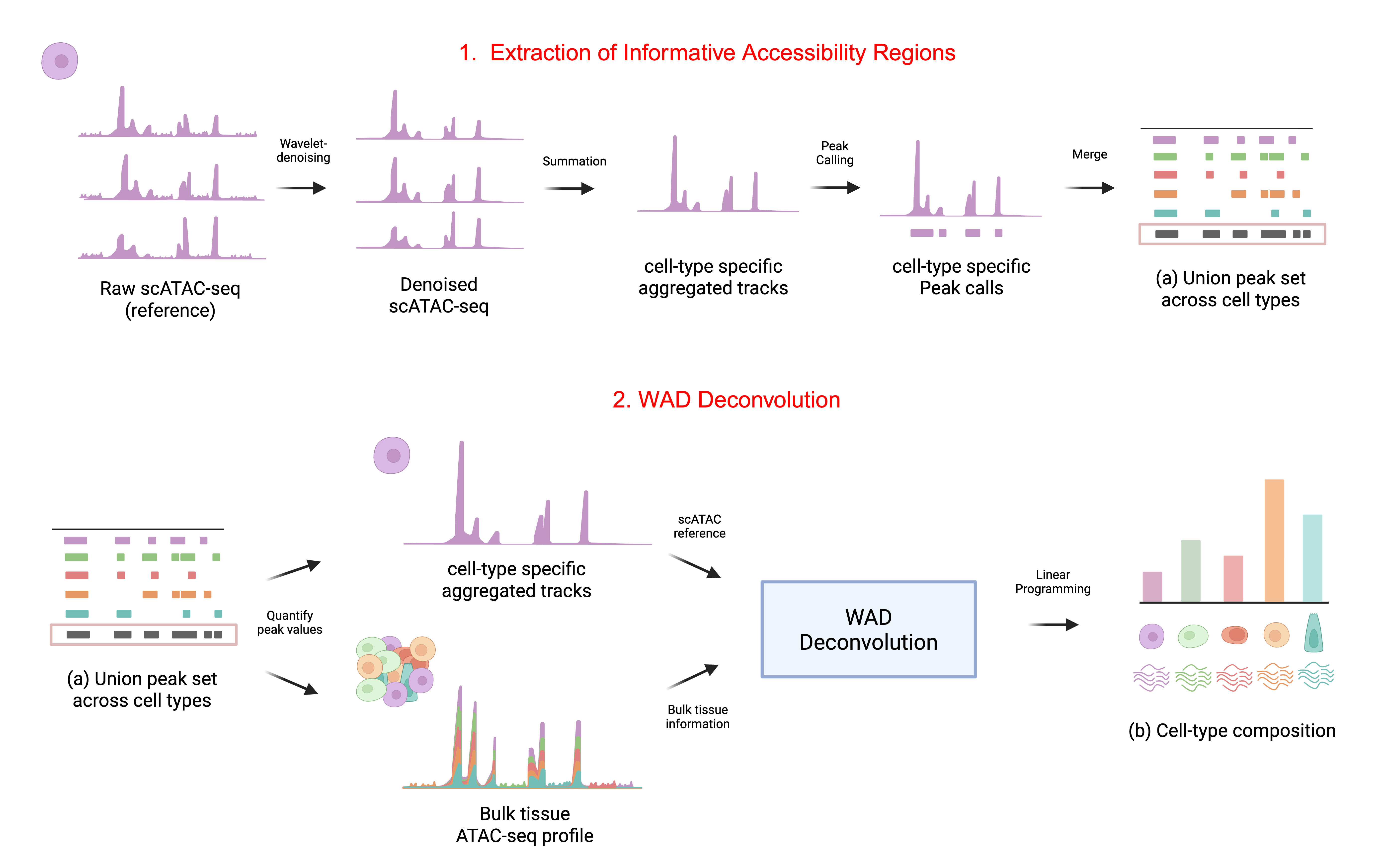
We present WAD (Wavelet-based Accessible chromatin Deconvolution), a principled framework for robust estimation of cell type composition of bulk accessible chromatin data such as from the ATAC-seq assay. To determine informative reference cell profiles from single-cell accessible chromatin studies, WAD leverages wavelet-based denoising to suppress stochastic noise while preserving local chromatin continuity. Cell type proportion inference is reformulated as an L1-minimal linear programming problem, enabling scalable and interpretable solutions. Across 700 in silico pseudo-bulk mixtures generated from single-cell data, WAD achieved a consistently lower mean absolute error (MAE) and higher concordance (r > 0.85) than existing machine learning-based methods. These results demonstrate that wavelet-based feature extraction provides a biologically grounded and computationally efficient approach to chromatin signal deconvolution.
WAD: a wavelet-based linear programming method using L1-minimal reconstruction loss for accessible chromatin data deconvolution
Jeongho Chae, Benjamin McMichael, Terrence S. Furey
Preprint 2025
We present WAD (Wavelet-based Accessible chromatin Deconvolution), a principled framework for robust estimation of cell type composition of bulk accessible chromatin data such as from the ATAC-seq assay. To determine informative reference cell profiles from single-cell accessible chromatin studies, WAD leverages wavelet-based denoising to suppress stochastic noise while preserving local chromatin continuity. Cell type proportion inference is reformulated as an L1-minimal linear programming problem, enabling scalable and interpretable solutions. Across 700 in silico pseudo-bulk mixtures generated from single-cell data, WAD achieved a consistently lower mean absolute error (MAE) and higher concordance (r > 0.85) than existing machine learning-based methods. These results demonstrate that wavelet-based feature extraction provides a biologically grounded and computationally efficient approach to chromatin signal deconvolution.